
A Fatherly Leader’s Daily Life
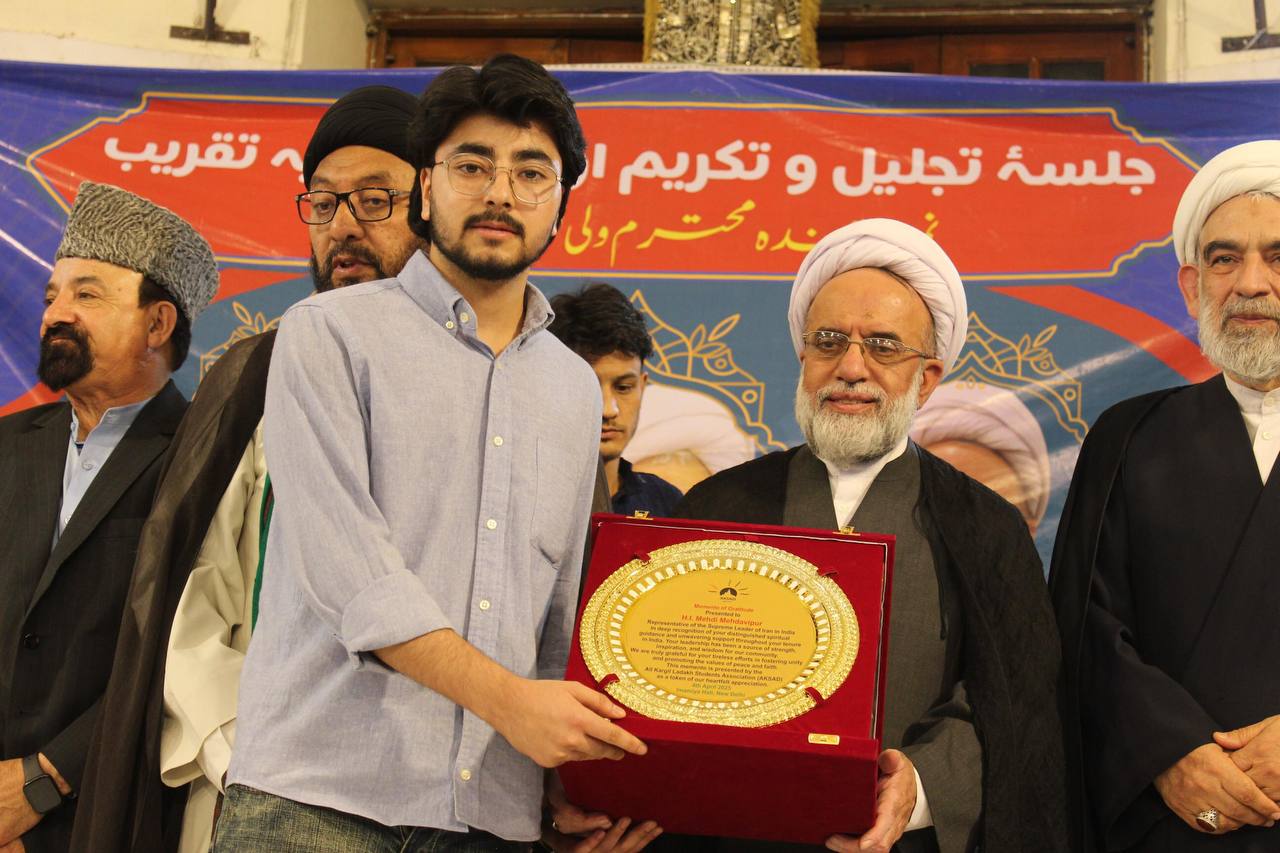
(The Character and Services of Hujjat al-Islam wal-Muslimeen Haj Agha Mahdi Mahdavipour)

Written by: Jawad Habib (Head of the Office of the Representative of the Supreme Leader in India)
Introduction:
“And We made them leaders, guiding by Our command when they were patient and when they were certain of Our signs.” (Qur’an 32:24)
In the course of human history, there appear certain personalities whose silence is eloquence, whose simplicity is grandeur, and whose service is leadership. Their legacy does not remain confined to books, but penetrates deep into the hearts of people. Hujjat al-Islam wal-Muslimeen Haj Agha Mahdi Mahdavipour (may his blessings endure), the honorable Representative of the Supreme Leader in India, is one such personality. His existence is not only that of the head of an office, but also that of a mentor, teacher, reformer, and spiritual father.
The journey of his services over the past fifteen years has gone far beyond appointments, meetings, or mere representation. In a great, diverse, and intellectually fertile land like India, he has kept the lamp of Islamic values, fraternity and unity, youth training, knowledge, and spirituality illuminated.
The Office – More Than an Institution, a Training Ground!

Agha Mahdavipour’s office is, in fact, a training ground. Every visitor—whether employee or guest, student or scholar—returns having learned something. This environment is imbued with gentleness, discipline, attention, respect, and spirituality, where everything radiates balance and blessing. In his view, no task is “trivial.” Every moment is an opportunity, and every action a form of worship. The office order, file arrangement, and meeting schedules all run with a spiritual and educational spirit. What might outwardly appear as mere formality elsewhere becomes a “responsibility” and “moral duty” here.
A Fatherly Shade
His conduct reflects the same compassion that a kind father shows his children. Praying for employees in illness, taking personal interest in their family difficulties, consoling the distressed, and silently helping the needy—these are his everyday practices. I have personally witnessed how, on many occasions, he guided a young employee facing academic struggles or a female staff member dealing with household problems, just like a caring elder of the family. To him, every individual is not merely a “working hand” but a “heart-bearing human being.” This is what gives life to his leadership.
Simplicity and Self-Respect
Imam Ja‘far al-Sadiq (a) said: “Call people to religion, not with your tongues but with your actions.”
If ever simplicity on the outside and greatness on the inside were beautifully combined, it is in Agha Mahdavipour’s being. He neither seeks protocol, nor show and pomp, nor comfort. Always dressed simply, radiating joy, and inviting thought and action—this is his constant state. Welcoming guests himself, arranging tea or water personally—these are part of his routine. This is not mere humility, but a teaching—an educational practice that demonstrates leadership as inseparable from service.
Training the Youth

If one aspect of his fifteen-year service shines brightest, it is his focus on youth. He repeatedly emphasized: “Youth are the assets of the nation. If they are properly nurtured, the destiny of a nation can change.” As the Qur’an says: “They were young men who believed in their Lord, so We increased them in guidance.” (18:13)
He always found time for the youth, listened to their questions, held intellectual gatherings, and advised them to advance with knowledge, practice, manners, and insight. Across many cities of India, he organized Islamic and moral training camps, unity conferences, and study workshops for youth. To them, he was not only a teacher, but also a companion, an ideal, and a mentor.
Consultation, Courtesy, and Scholarly Leadership
He never imposed decisions. In every matter, big or small, he sought consultation, valued others’ opinions, and welcomed differing views with a smile. Alongside his scholarly taste, deep study, and fiqh-based insight, he carried humility, gentleness, and broadmindedness in his character. This balance made him respected and imitable for both the learned and the general public.
A Wise and Visionary Administrator
He was a careful, informed, and farsighted administrator, fully aware of the sensitive demands of religious, cultural, and academic activities in a land of diverse religions and traditions. His approach was never coercive or dictatorial, but full of wisdom, insight, and kindness.
A Skilled Mentor and Character Builder
He excelled in nurturing personalities. Overlooking minor mistakes, he gave individuals the chance to grow and self-correct. Today, many prominent and successful faces in India are the fruits of his training and dedication—an invaluable legacy he leaves behind.
A Model of Generosity
His benevolence and generosity are well known. No one ever left his home or office empty-handed. His kindness won countless hearts.
An Embodiment of Patience and Forbearance
Throughout his years of service, no trace of anger or harshness was ever seen on his face. He always conversed with calmness and a smile. His radiant, cheerful presence gave peace to hearts, and he solved even the toughest problems with gentleness and pleasantness.
Steadfastness
Despite his age, he never showed signs of fatigue or slackness. Whether long journeys, multiple programs, or harsh weather across India and beyond, he remained active and energetic. His perseverance gave courage and strength to others.
Fifteen Years of Service

Agha Mahdavipour’s fifteen-year representation in India was not just a diplomatic assignment, but a mission of intellectual, scholarly, and spiritual revival. He built bridges of unity and love not only among Shia and Sunni scholars but also across different sects and schools of thought.
His connection with scholars and intellectuals was not limited to formal meetings but was based on a genuine intellectual and spiritual bond. He actively participated in scholarly gatherings, listened carefully, and engaged in meaningful exchanges. Many Indian universities, seminaries, and intellectual circles benefited from his guidance.
Wilayat al-Faqih and the Islamic Revolution
Leadership has always been a vital theme in Islamic history. In Islam, leadership is not merely about power or governance, but about intellectual, moral, and religious guidance. The Islamic Revolution of Iran introduced this concept to the world as Wilayat al-Faqih—where an upright, insightful, and farsighted jurist leads the nation.
Agha Mahdavipour introduced this system in India with wisdom and prudence, in a land diverse, democratic, and secular. His approach was neither emotional nor political sloganizing, but intellectual and ethical.
To him, the Islamic Revolution was not simply a political upheaval but a comprehensive intellectual, civilizational, and spiritual awakening. He presented its message in India through three key aspects:
- Promoting Islamic unity, fostering dialogue and brotherhood between Shia, Sunni, and other schools of thought.
- Prioritizing youth training through workshops, educational camps, and intellectual gatherings.
- Presenting Islamic civilization as an alternative model to Western materialism—rooted in Qur’anic principles of knowledge, justice, ethics, and spirituality.
Interfaith Harmony and Cooperation
In India’s multi-religious and culturally diverse society, interfaith dialogue and harmony are both a religious and social necessity. Agha Mahdavipour played the role of a religious ambassador, ethical guide, and cultural bridge. He extended the teachings of the Islamic Revolution beyond Muslims, reaching Indian society through interfaith meetings, dialogues, and collaborations.
His interfaith efforts rested on two pillars:
- The Qur’an’s universal invitation to dialogue and shared values (“Come to a common word between us and you” – 3:64).
- The example of Imam Khomeini (r) and the Supreme Leader, emphasizing sympathy with the oppressed and global human unity.
He met leaders of Hinduism, Sikhism, Christianity, Jainism, and Buddhism in cities like Delhi, Lucknow, Patna, Bangalore, and Kolkata. These meetings focused on tolerance, social cooperation, and ethical values. He organized conferences on peace, justice, family system, and environmental protection, with participation from scholars of multiple faiths.
Most notably, he presented Imam Husayn’s (a) sacrifice not merely as a Shia creed, but as a universal human message, respected by all faiths. This positioned Imam Husayn’s legacy as a “shared divine heritage,” opening new doors for interfaith harmony.
Strengthening Iran–India Relations
The bond between Iran and India has always been rooted in cultural, civilizational, and spiritual ties. These two ancient Asian civilizations, with histories spanning millennia, have long enjoyed exchanges in Persian language, Islamic mysticism, and intellectual traditions.
In this context, Agha Mahdavipour stands as a distinguished personality who, for many years as the Supreme Leader’s Representative, strengthened Iran–India relations. He was not only a religious figure but also a cultural, social, and public leader who played a key role in deepening ties on multiple fronts.
The Ladakh Journey and Its Impact
Ladakh, in northern India, is known for its natural beauty, cultural diversity, and ancient tradition of religious harmony, where Buddhists, Shias, Sunnis, Hindus, Sikhs, and Christians live together in brotherhood.
When Agha Mahdavipour visited Ladakh as the Representative of the Supreme Leader, his journey was not just a religious mission but a cultural and intellectual message that touched the hearts of all communities.
The significance of the visit was elevated when the UT Ladakh government, local administration, and public representatives formally invited him as a “Guest of Honor.” This recognition reflected the respect for his services not only among religious circles but also at governmental and social levels.
During this historic trip, he met with Shia and Sunni scholars, Buddhist monks, Hindu priests, Christian pastors, and social leaders. Discussions focused on tolerance, humanity, and intellectual harmony. He emphasized, with Qur’anic verses and the teachings of Imam Khomeini (r) and the Supreme Leader, that Islam advocates peaceful and dignified relations with all faiths.
Addressing mosques, Imambargahs, educational institutions, and youth gatherings in Ladakh, he presented Islam as a living, merciful, and civilizational message. He stressed that youth should lead not only in spiritual zeal but also in knowledge, insight, and service—the true message of the Islamic Revolution.
This Ladakh visit became a model of intellectual, spiritual, and interfaith harmony. The recognition of his presence by the government and society testified to his deep influence and respect in India. His humility, scholarship, and goodwill proved that a true religious leader can bridge divides and bring communities together.
Conclusion
Hujjat al-Islam wal-Muslimeen Agha Mahdi Mahdavipour (may his blessings endure) is among those personalities who combine knowledge, ethics, and sincerity, presenting a model of living and effective leadership. He is not merely an individual but a school of thought—a silent revolutionary who united hearts, nurtured generations, and created an atmosphere where knowledge, literature, love, faith, and service breathe together.
As a humble servant, I consider every moment spent in his company as a treasure of my life. What I learned from him was not only knowledge, but a way of life—a style of living that refines the soul while uplifting others.
“O Allah! Prolong his life, bless his deeds, and make us among those who walk his path and benefit from his light.”
I pray that the Almighty prolongs his life, accepts his services, and grants us the honor of following in his footsteps.


Comments
No comments yet. Be the first to write one.
Comments are closed.