
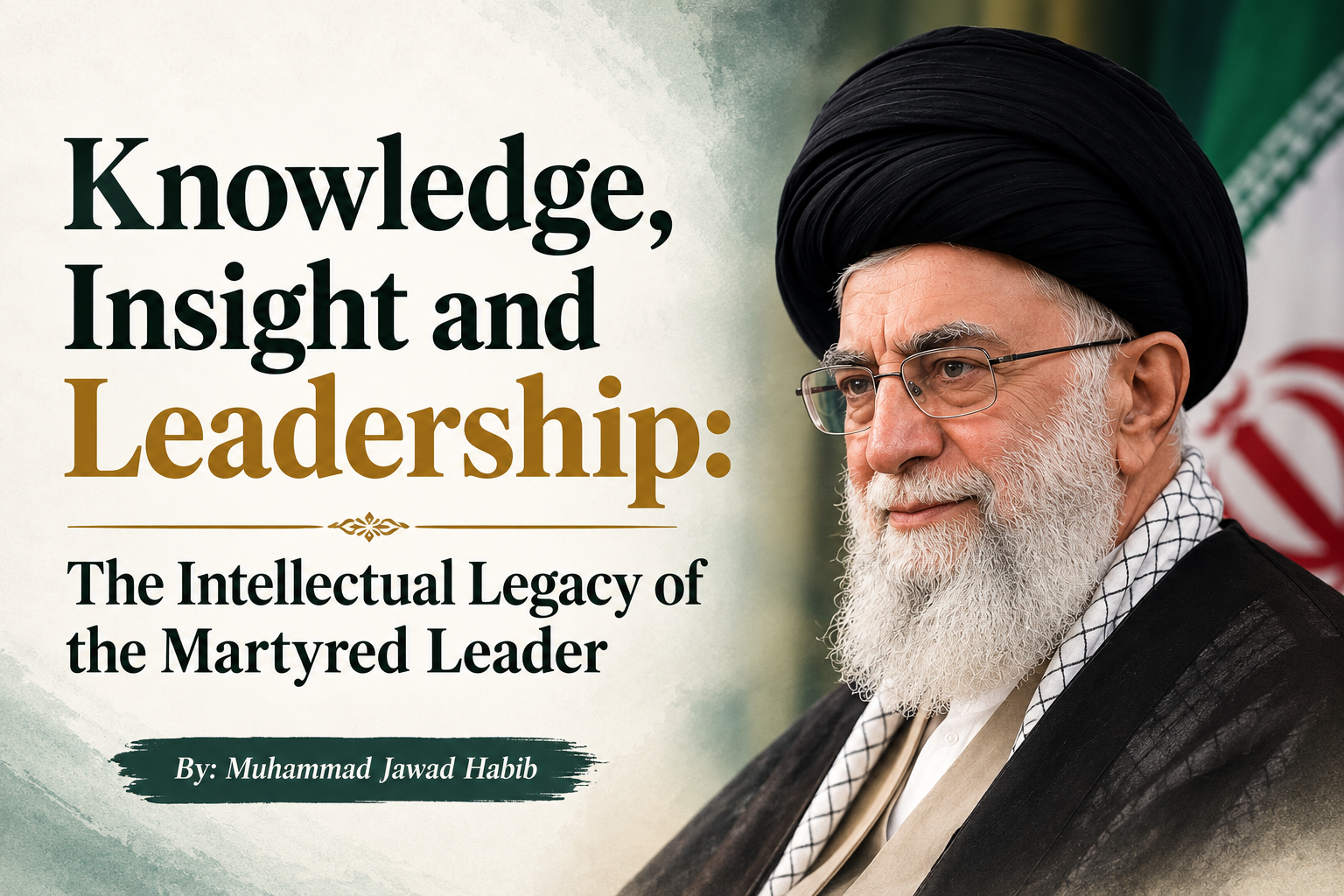
Knowledge, Insight and Leadership: The Intellectual Legacy of the Martyred Leader
By Muhammad Jawad Habib

History is shaped not only by events, but also by personalities whose ideas transcend the boundaries of their office, era, and political responsibilities. Some figures leave behind more than a record of decisions and achievements; they leave a school of thought, a vision, and an intellectual legacy that continues to influence generations. The personality of the Martyred Leader of the Islamic Revolution, Ayatollah al-Uzma Sayyed Ali Hosseini Khamenei (may God’s mercy be upon him), may be viewed from this broader perspective. His intellectual and political life reflected a remarkable combination of scholarly depth, jurisprudential knowledge, political and administrative insight, strategic vision, self-confidence, perseverance, and a sustained effort to present Islamic thought to the wider world. Among the many dimensions of his personality, three stand out in particular: knowledge, insight, and leadership. Together, they provide a framework for understanding the intellectual foundations of his leadership and the legacy he sought to leave for future generations.

Knowledge: The Foundation of Leadership
The true strength of a religious leader lies not merely in political experience or administrative ability, but in the intellectual and scholarly foundation upon which his thought and decisions are built. One of the most distinctive characteristics of the Martyred Leader was his jurisprudential scholarship and intellectual breadth. Alongside his studies in Islamic sciences, he developed a deep understanding of history, politics, culture, economics, international relations, defence, and social affairs.
For him, religion and politics were not isolated spheres. Rather, religion provided a comprehensive framework for guiding individual and collective life. Jurisprudence was not merely a discipline concerned with personal acts of worship and legal rulings; it also offered principles for justice, governance, social responsibility, and the protection of human dignity.
The Qur’an draws attention to the elevated position of knowledge:
﴿قُلْ هَلْ يَسْتَوِي الَّذِينَ يَعْلَمُونَ وَالَّذِينَ لَا يَعْلَمُونَ﴾
“Say: Are those who know equal to those who do not know?”
(Qur’an, 39:9)
The Islamic tradition likewise accords a distinguished position to scholars. The Prophet Muhammad (peace and blessings be upon him and his Ahl al-Bayt) is reported to have said:
«العُلَمَاءُ وَرَثَةُ الْأَنْبِيَاءِ»
“The scholars are the heirs of the Prophets.”
Yet knowledge alone does not complete leadership. Knowledge becomes a source of genuine leadership when it is accompanied by piety, insight, and action. The Qur’an commands:
﴿اعْدِلُوا هُوَ أَقْرَبُ لِلتَّقْوَىٰ﴾
“Be just; that is nearer to righteousness.”
(Qur’an, 5:8)
Thus, for a religious leader, knowledge is not merely a collection of information; it is a responsibility. It carries with it the obligation to contribute to the reform of society, uphold justice, defend truth against oppression, and safeguard human dignity. It is at this intersection of knowledge, piety, and insight that scholarship becomes leadership.
Insight: The True Capital of Leadership
Leadership is not simply the ability to make major decisions. It is the ability to understand the circumstances, opportunities, risks, and consequences that lie behind those decisions.
A second prominent feature of the Martyred Leader was his political and administrative insight and his extensive knowledge of diverse fields. According to political analyst Hamidreza Taraghi, some officials and experts observed that his understanding of specialised subjects was, at times, broader and deeper than that of those directly responsible for those fields.
Such breadth of vision enables a leader to move beyond merely reacting to events. It allows him to analyse developments, recognise emerging challenges, assess available capabilities, and determine a strategic direction for the future.
The leadership of a major political system requires an ability to understand realities on the ground while simultaneously taking into account domestic capabilities, international developments, changing political circumstances, the strategies of adversaries, and future possibilities.
This explains the importance attached in his political thought to self-confidence, independence, national dignity, and reliance on domestic capabilities.
One of the concepts associated with this outlook is “Ma Mitavanیم” — “We can.” More than a political slogan, it represents a philosophy of self-belief: the conviction that a nation should not define its future through dependence upon others, but should recognise and develop its own intellectual, human, scientific, and material capabilities.
No nation can achieve genuine strength if it has lost confidence in itself. The Qur’an reminds believers:
﴿وَلَا تَهِنُوا وَلَا تَحْزَنُوا وَأَنْتُمُ الْأَعْلَوْنَ إِنْ كُنْتُمْ مُؤْمِنِينَ﴾
“Do not lose heart or grieve; you will have the upper hand if you are believers.”
(Qur’an, 3:139)
The verse carries a broader lesson about resilience and collective confidence. Material resources alone do not determine the strength of a nation. Faith, determination, knowledge, unity, and confidence in one's own capabilities can become decisive forces in confronting major challenges.
In this sense, insight is more than seeing events; it is understanding what lies beneath them and recognising where they may lead. Self-confidence, in turn, transforms insight into purposeful action.
Leadership: Turning Knowledge and Insight into Purpose
Knowledge provides the foundation, and insight provides direction, but leadership is the ability to transform both into a coherent course of action.
The legacy of the Martyred Leader can therefore be understood not simply through the decisions associated with his political career, but through the relationship between knowledge, insight, responsibility, and action.
Leadership, in this sense, is not merely authority. It is responsibility before God, society, and history. It requires the ability to recognise challenges, preserve principles in difficult circumstances, and inspire a society to believe in its own capacity to progress.
This understanding of leadership places particular emphasis on responsibility rather than privilege, service rather than power, and vision rather than short-term reaction.
The Qur’anic principle of justice provides an important foundation for this conception of leadership:
﴿إِنَّ اللَّهَ يَأْمُرُ بِالْعَدْلِ وَالْإِحْسَانِ﴾
“Indeed, Allah commands justice and excellence.”
(Qur’an, 16:90)
From this perspective, authority is not an end in itself. It is a trust whose purpose should be to promote justice, preserve social stability, protect human dignity, and serve the broader interests of society.

Beyond Borders: The Global Dimension of Islamic Thought
Another significant dimension of the Martyred Leader’s intellectual legacy was his effort to introduce Islamic thought to audiences beyond the Muslim world.
His message was not confined to Iran or to Muslim societies. His well-known address to the youth of Europe and North America was particularly significant in this regard. Rather than asking young people to accept a predetermined political position, he encouraged them to approach Islam through its authentic sources and to examine the Qur’an and Islamic teachings directly.
The significance of this approach lies in its emphasis on research, reflection, independent study, and direct engagement with sources.
The Qur’an describes human diversity as an opportunity for mutual understanding:
﴿يَا أَيُّهَا النَّاسُ إِنَّا خَلَقْنَاكُم مِّنْ ذَكَرٍ وَأُنثَىٰ وَجَعَلْنَاكُمْ شُعُوبًا وَقَبَائِلَ لِتَعَارَفُوا﴾
“O mankind, indeed We have created you from a male and a female, and made you peoples and tribes so that you may know one another.”
(Qur’an, 49:13)
In an increasingly interconnected yet divided world, the call for direct understanding and genuine intellectual engagement remains significant.
The global promotion of Islamic thought, therefore, should not be understood merely as the promotion of a particular country or political system. At its broader intellectual level, it involves presenting Islamic concepts of justice, human dignity, spirituality, ethical responsibility, freedom, and self-confidence to the wider world.
Islam: A Vision of Justice and Human Dignity
To view the Martyred Leader merely as a political figure would be to overlook a significant part of his intellectual legacy. His thought placed emphasis on authentic Islam, justice, dignity, freedom, self-reliance, perseverance, and service to humanity.
Islam, in this understanding, is not limited to private worship or individual spirituality. It also offers principles for collective life, social justice, ethical governance, and human responsibility.
The Qur’an declares:
﴿إِنَّ اللَّهَ يَأْمُرُ بِالْعَدْلِ وَالْإِحْسَانِ﴾
“Indeed, Allah commands justice and excellence.”
(Qur’an, 16:90)
This concise Qur’anic principle captures an essential dimension of Islamic social thought: authority is a trust, and its legitimacy is inseparable from responsibility and justice.
The greatness of a leader, therefore, cannot be measured solely by political decisions or governmental achievements. It must also be assessed by the extent to which he contributes to the development of knowledge, awareness, self-confidence, responsibility, and moral consciousness within society.
Beyond a Personality: An Intellectual Legacy
When the three dimensions of knowledge, insight, and leadership are considered together, a broader picture emerges.
Knowledge provides the foundation. Insight gives direction. Leadership transforms both into collective purpose.
This is the point at which a personality begins to transcend his own era and becomes an intellectual legacy.
History shows that individuals eventually leave the political stage, but ideas that become embedded in the minds, character, and collective life of people can continue to live for generations.
The true legacy of a leader, therefore, lies not merely in his office, political tenure, or individual decisions, but in the values and ideas he leaves behind.
The intellectual legacy associated with the Martyred Leader can be viewed through this lens: a vision in which knowledge is joined with insight, authority with responsibility, self-confidence with trust in God, perseverance with hope, and Islamic thought with human dignity.
The Question for Our Time
The contemporary world is experiencing intellectual uncertainty, cultural tensions, and profound questions of identity. The extraordinary abundance of information has made access to knowledge easier, yet distinguishing truth from falsehood has become increasingly difficult.
In such an environment, it is not enough for a nation to take pride in its past. It must also possess a clear intellectual foundation, a sense of identity, and the confidence to build its future.
This is where the enduring importance of knowledge, insight, leadership, and moral responsibility becomes evident.
The study of the Martyred Leader’s personality invites us to reflect on a fundamental truth: the deepest strength of nations does not lie solely in wealth, technology, political power, or material resources. The enduring strength of a nation lies in a living intellectual vision that connects people to their identity, gives them confidence in their capabilities, and inspires them to build the future.
Perhaps this is the greatest legacy that any remarkable leader can leave behind: to transcend his own era and leave a vision that does not merely remind future generations of the past, but gives them the courage to understand the present, shape the future, and remain steadfast in their principles.



Comments
No comments yet. Be the first to write one.
Comments are closed.