
Fatimid Life and Our Society
This article explores the life and teachings of Lady Fatimah al-Zahra and their relevance to women's education, family life, ethics, social service, and justice in contemporary society.
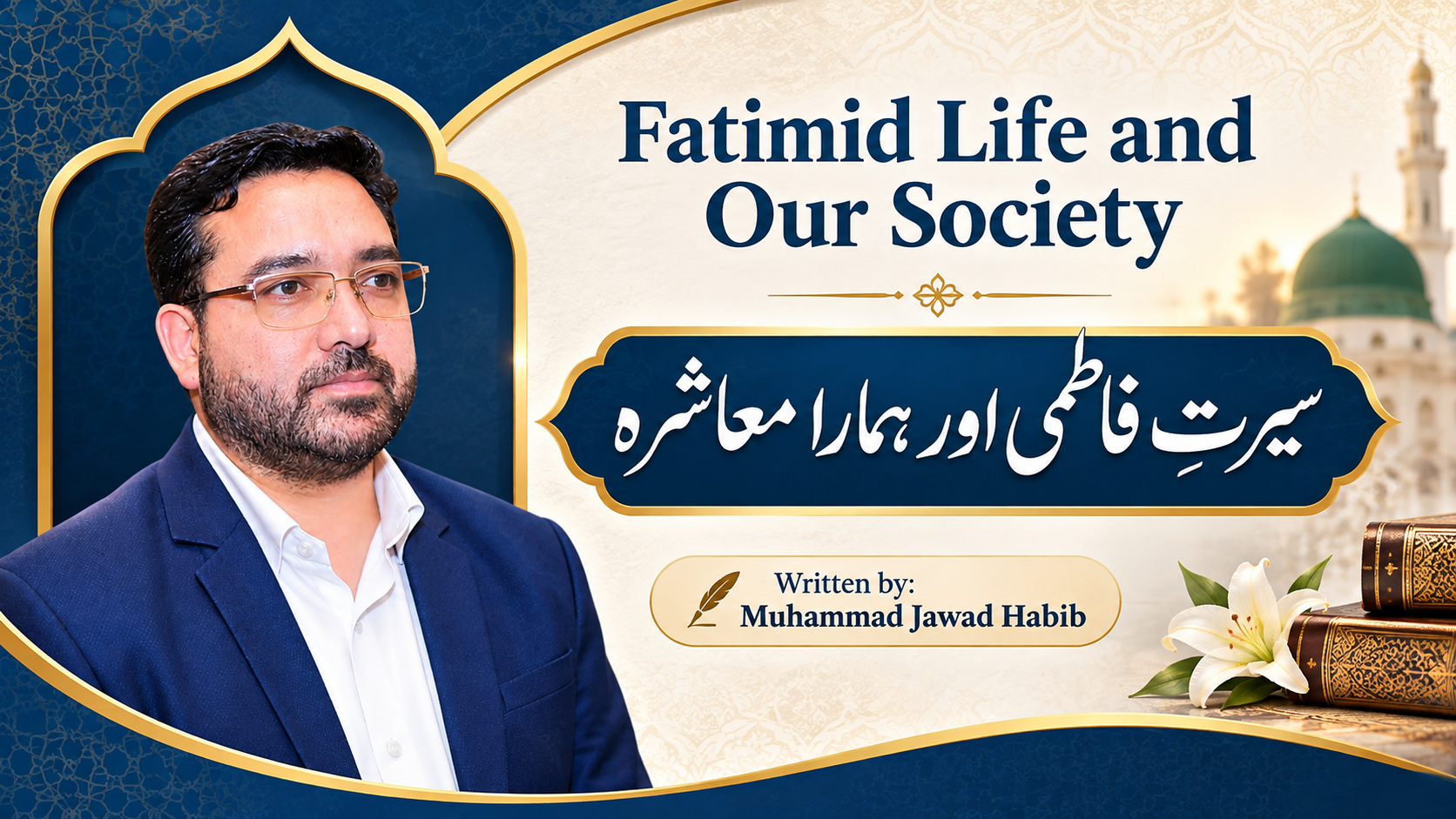
Fatimid Life and Our Society
Written by: Muhammad Jawad Habib
Introduction
In human history, there are certain personalities whose greatness is not confined to a particular era, region, or social system. Rather, the imprint of their lives becomes a source of guidance for people in every age. Lady Fatimah al-Zahra (peace be upon her) is one of these great personalities. She was the noble daughter of the Messenger of Allah, Prophet Muhammad (peace and blessings be upon him and his family), the wife of Imam Ali (peace be upon him), the mother of Imam Hasan and Imam Husayn (peace be upon them both), and a distinguished member of the Household of Prophethood. In Islamic tradition, her status is not merely that of a revered historical figure; she represents a comprehensive model of faith, piety, knowledge, morality, chastity, steadfastness, and recognition of the truth.
In Surah al-Kawthar of the Holy Qur'an, it is stated: “Indeed, We have granted you al-Kawthar.” Various interpretations of this chapter have been presented. In the Shi'a exegetical tradition, Lady Fatimah al-Zahra (peace be upon her) and her blessed progeny are particularly associated with the meanings of this verse. Here, the concept of al-Kawthar is not limited to abundance of offspring; it also draws attention to abundant goodness, the enduring influence of a legacy, and the spiritual and moral blessings that are transmitted from one generation to another.
When studying the life of Lady al-Zahra (peace be upon her), it is important to remember that her greatness cannot be confined to a single aspect, such as domestic life, worship, or chastity. Her personality brings together devotion to God, knowledge and understanding, family upbringing, social service, speaking the truth, and principled steadfastness. This comprehensiveness gives her life exceptional significance for women today as well.
In the contemporary era, women are active in various fields of life, including education, research, medicine, politics, journalism, teaching, economics, and social service. In this context, benefiting from the Fatimid way of life requires understanding its moral and spiritual principles and applying them to present-day social conditions with wisdom, insight, and responsibility.
For Muslim women today, the fundamental question is not how emotionally attached they are to the Fatimid way of life, but to what extent that attachment is reflected in their knowledge, morals, decisions, family relationships, and social roles. Are they serious about acquiring knowledge? Do their manners bring comfort to others? Do they combine justice with love in raising their children? Do they help those in need? Are they aware of their rights and responsibilities? And do they demonstrate principled steadfastness in times of disagreement and difficulty?
1. Worship and Devotion
One prominent aspect of the life of Lady Fatimah al-Zahra (peace be upon her) was her deep connection with God Almighty and her extraordinary devotion to worship. Her worship was not confined to outward acts; it was characterized by divine understanding, sincerity, humility, and a sense of responsibility. Reports mention her night vigils, prayers, intimate supplications, and her seeking goodness for others.
A well-known report attributed to Imam Hasan al-Mujtaba (peace be upon him) relates that he saw his noble mother engaged in worship and supplication on the night preceding Friday. It is also reported that she prayed for the believers. When he asked her why she did not pray for herself, it is related that she taught him to give priority to the neighbours.
This account, when presented with its chain of transmission and wording verified against the original hadith sources, illustrates an important ethical dimension of worship: genuine devotion frees a person from selfishness and makes them sensitive to the suffering, needs, and well-being of others. One consequence of a relationship with God is fulfilling the rights of His creation.
In the life of Lady al-Zahra (peace be upon her), worship and social responsibility are not opposites; rather, they complement one another. Worship purifies the inner self, while respecting the rights of others gives that purity practical expression in everyday life.
In today's fast-paced world, women must continually strive to balance education, employment, household responsibilities, children, social relationships, and personal obligations. In such circumstances, worship should not be regarded merely as an additional responsibility; it should be understood as a source of spiritual peace, moral strength, and renewed awareness of life's purpose.
The Fatimid way of life invites us to ask ourselves: Is our worship improving our character? Do our prayers include the well-being of others? Do we make life easier for those in need in our homes, neighbourhoods, and society? The Fatimid teaching is that the light of worship should also be visible in a person's character, relationships, and social conduct.
2. Knowledge and Understanding
An important aspect of the personality of Lady Fatimah al-Zahra (peace be upon her) was her knowledge and understanding. She benefited from the upbringing and teaching of the Messenger of Allah (peace and blessings be upon him and his family) and attained a distinguished position in Islamic teachings, Qur'anic knowledge, and religious insight. The sermons attributed to her, particularly the Sermon of Fadak, are notable examples of her reasoning, eloquence, understanding of the Qur'an, and religious and social awareness.
The Sermon of Fadak discusses monotheism, prophethood, acts of worship, Islamic rulings, social responsibilities, and political and collective circumstances. Its significance also lies in the fact that it presents a woman discussing religious principles and collective issues through structured reasoning.
The Mus'haf of Fatimah is also mentioned among the intellectual and religious legacy attributed to Lady Fatimah (peace be upon her). According to Shi'a reports, this compilation is regarded as distinct from the Holy Qur'an; it is incorrect to describe it as a substitute for the Qur'an or as part of it. Scholarly discussions of this subject should present the relevant reports and their interpretations alongside their original sources.
Her life makes clear that the purpose of knowledge is not merely to accumulate information, but to distinguish truth from falsehood, understand reality, make sound decisions, and develop responsible conduct.
In the present era, quality education, scientific research, religious understanding, reading, and intellectual development are more important than ever for women. Obtaining a degree alone does not guarantee intellectual maturity. Genuine knowledge broadens a person's thinking, strengthens their character, and makes their decisions more responsible.
Muslim women today should develop their abilities in modern sciences, digital literacy, languages, research, and critical reading, alongside their understanding of religious teachings. Religious commitment and intellectual advancement should not be placed in opposition to one another.
It is also essential for women to consult reliable sources on religious matters, avoid accepting unverified social media messages without investigation, and maintain intellectual integrity when discussing disputed issues. The Fatimid way of life reminds us that a woman of dignity combines faith with knowledge, belief with insight, and opinion with evidence.
3. Teaching and Educating Others
Alongside the acquisition of knowledge, the teaching of others is another prominent aspect of the life of Lady Fatimah al-Zahra (peace be upon her). Reports attributed to her mention that she answered women's religious questions and informed them about the rulings of religion.
A well-known account relates that a woman came to ask her about a prayer-related issue concerning her mother and asked several questions. According to the account, Lady Fatimah did not show displeasure at answering these questions; rather, she regarded the effort to acquire knowledge as worthy of appreciation.
The central message of this account is that restricting knowledge to a select few or making learners feel ashamed of their questions is contrary to sound education. A healthy intellectual environment encourages questions, provides answers supported by evidence, and treats knowledge as a means of serving humanity.
In the Fatimid understanding of education, teaching is not limited to formal instruction. Religious awareness, moral development, and intellectual guidance are also integral parts of it.
Women today have numerous opportunities to promote education. As teachers, researchers, writers, religious educators, advisers, and social workers, they can play an important role in the intellectual development of society.
When educated women use their knowledge not only for personal advancement but also to guide other women, students, and disadvantaged groups, the benefits can extend beyond individuals to society as a whole.
In the field of religious education in particular, learning centres, study circles, and training programmes for women are important platforms for promoting reliable knowledge, questions and answers, and moral development. The moment for reflection is this: How much light have we brought into the lives of others through the knowledge we have acquired?
4. Chastity and Hijab
Chastity, modesty, and dignity hold a fundamental place in the life of Lady Fatimah al-Zahra (peace be upon her). Islamic teachings associate hijab and the lowering of the gaze with human dignity, moral responsibility, and social etiquette. However, when studying the Fatimid way of life, it is important to understand not only the outward aspect of hijab but also its ethical and intellectual foundations.
According to a well-known saying attributed to her, the best conduct for a woman is that she should neither look at a non-mahram man nor be seen by a non-mahram man. This report is cited in discussions of the virtue of chastity and modesty. However, its meaning should be understood alongside other teachings of the Qur'an and Sunnah, social necessities, and jurisprudential discussions. It should not be interpreted as prohibiting every form of legitimate social participation or necessary communication by women.
It should also be remembered that Lady Fatimah (peace be upon her) engaged in intellectual and collective discussions when necessary, reasoned in defence of the truth, and expressed her position on religious and social matters. This demonstrates that chastity and dignified participation in society should not necessarily be regarded as contradictory.
In Islamic ethics, hijab concerns not only clothing but also one's gaze, speech, intentions, manner of interaction, and respect for the dignity of others. Discussions of this subject should present women's self-respect, agency, religious responsibilities, and social protection in a balanced manner.
In the age of social media, trends involving outward display, comparisons of physical beauty, unrealistic standards of living, and constant comparison with others have created psychological and social pressure for many women. In such an environment, the concept of chastity and modesty invites people to understand their worth through character, knowledge, ethics, and personality rather than determining it solely by appearance or the attention they receive from others.
Muslim women should take care to uphold their religious principles and personal dignity in their clothing, speech, online presence, and social relationships. Likewise, society and families have a responsibility to treat women with respect and not promote humiliation, ridicule, or unnecessary restrictions in the name of hijab.
Scholarly discussion of hijab becomes more effective when it is conducted with wisdom, ethics, evidence, and respect, rather than through superficial criticism or judgement of other people's character. The message of the Fatimid way of life is that chastity should bring dignity to a person's character and remain consistent with knowledge, morality, and responsibility.
5. Married Life
The married life of Lady Fatimah al-Zahra (peace be upon her) and Imam Ali (peace be upon him) is presented in Islamic history as an important exemplary model. Their life was marked by simplicity, faith, mutual companionship, patience, and responsibility. Despite limited material resources, this family made religious and moral values the foundation of its life.
Reports concerning the domestic life of Lady Fatimah (peace be upon her) mention her carrying out household tasks, raising children, and engaging in worship and remembrance of God. Similarly, Imam Ali's life is marked by hard work, effort, economic responsibility, and dedication to his family.
Reports also discuss the division of household tasks and the allocation of responsibilities between Lady Fatimah (peace be upon her) and Imam Ali (peace be upon him). These reports should be understood within their historical and jurisprudential contexts. The central ethical lesson to be drawn from them is the importance of fulfilling responsibilities, cooperating with one another, appreciating one another, and working towards shared goals for the success of a family.
When applying the Fatimid way of life to modern married life, it is important not to impose historical social circumstances indiscriminately upon every contemporary situation. Today, in many families, both husband and wife fulfil economic responsibilities, while in some families one person devotes more time to caring for the home and children. In these circumstances, a fair division of responsibilities based on mutual agreement becomes especially important.
Today, marriage is sometimes judged by outward splendour, expensive ceremonies, dowry demands, social status, and financial standards. In this trend, genuine companionship, morality, responsibility, and mutual trust can be pushed into the background.
The life of Lady Fatimah (peace be upon her) invites us to consider how much importance we give to honesty, good character, responsibility, mental compatibility, and respect when choosing a life partner. Financial stability is certainly an important practical consideration, but it should not become the sole measure of a person's character or compatibility.
Similarly, expecting sacrifice and service only from the woman in married life is not a comprehensive ethical approach. Both husband and wife must respect each other's rights, cooperate during difficulties, and strive to resolve disagreements through dialogue and justice. The Fatimid message is that a successful marriage is founded not merely on an abundance of resources, but on faith, love, responsibility, trust, and mutual respect.
6. Ethics and Character
In the life of Lady Fatimah al-Zahra (peace be upon her), high moral standards, simplicity, humility, selflessness, and kindness towards others hold a prominent place. Worship and morality were not separate aspects of her life; rather, they were two dimensions of the same spiritual upbringing.
Accounts attributed to her mention helping those in need, praying for others, maintaining simplicity in domestic life, and treating those under her care with kindness. Studying her personality teaches us that true greatness is not demonstrated through position, wealth, or outward fame, but through character and one's treatment of others.
Reports concerning the presence of Lady Fiddah in her household and Lady Fatimah's kind treatment of her are also worthy of attention in this context. Historical details should be investigated when presenting these reports, but their ethical dimension highlights the importance of human dignity, service, and social responsibility.
Today, social competition, ostentation, brands, and the tendency to measure success by outward status have sometimes diminished the importance of simplicity and contentment. Comparing one's life with the lives of others on social media can also intensify unnecessary desires and feelings of deprivation.
The Fatimid way of life invites us to examine our own lives: Are the resources we possess a means of meeting our needs and helping others, or do we spend a large part of our energy trying to surpass other people?
Moral excellence also requires us to treat domestic workers, people with low incomes, female students, children pursuing their education, and socially disadvantaged people with respect. No person's dignity is diminished by their social class or economic circumstances.
7. Motherhood and Child-Rearing
Motherhood and the upbringing of children are among the most important aspects of the life of Lady Fatimah al-Zahra (peace be upon her). She played a fundamental role in raising Imam Hasan, Imam Husayn, Lady Zaynab, and Lady Umm Kulthum (peace be upon them). The faith, knowledge, courage, patience, truthfulness, and sense of human responsibility evident in the lives of these great personalities also demonstrate the importance of the educational environment of the Household of the Prophet.
Child-rearing is not merely a matter of meeting children's physical needs or providing them with material comforts. It is a long-term moral, intellectual, and emotional process. Children learn from their parents' words, but their parents' everyday behaviour, ways of handling disagreements, treatment of others, and fulfilment of responsibilities also have a profound influence on their personalities.
The life of Lady Fatimah (peace be upon her) draws our attention to the family as an important centre of human development. However, this responsibility should not be limited to mothers alone. Fathers, other family members, educational institutions, and society also share responsibility for raising children.
In today's world, challenges in child-rearing include digital media, academic pressure, mental health, moral confusion, social comparison, and a lack of time for parents. In these circumstances, love, discipline, dialogue, and positive role modelling become even more important.
Parents today need to consider what kind of success they want for their children. Is success merely a matter of high marks, a good job, wealth, and social standing, or should it also include honesty, compassion, self-confidence, justice, and respect for the rights of others?
An effective way to teach children religious values is not merely through advice, but also through demonstrating those values in practice. If children are taught to be truthful at home while lying is treated as normal in everyday affairs, a contradiction emerges in their upbringing. Similarly, demands for respect become effective only when children's own words and concerns are also heard attentively.
A mother's responsibility is important, but this does not mean that the entire burden of raising and caring for children should be placed upon her. Parents should cooperate in supporting their children's education, emotional needs, and moral development. The Fatimid message is that the best upbringing enables children to grow through knowledge and character, love and responsibility, self-confidence, and service to humanity.
8. Social Service and Human Compassion
Concern for others and helping those in need are fundamental themes in the life of Lady Fatimah al-Zahra (peace be upon her). Verses 8 and 9 of Surah al-Insan in the Holy Qur'an describe the quality of righteous servants who, out of love for God, feed the needy, the orphan, and the captive, seeking neither reward nor gratitude for their service. In the Shi'a exegetical tradition, these verses are also associated with the selflessness of the Household of the Prophet (peace be upon them).
The central ethical principle here is that goodness should not be pursued merely for personal fame or social recognition, but for the pleasure of God and the welfare of humanity. The scope of service to others is not limited to financial assistance. Listening to someone who is distressed, visiting the sick, guiding a student, speaking up for an oppressed person, and providing dignified support to someone in need are also forms of social service.
In the life of Lady Fatimah (peace be upon her), worship, selflessness, and collective concern form a meaningful unity: a person's goodness should extend beyond their own existence and bring benefit into the lives of others.
9. Speaking the Truth
An important historical aspect of the life of Lady Fatimah al-Zahra (peace be upon her) is that she took a position on certain significant collective and political issues of her time. The Sermon of Fadak is a fundamental historical text in this regard, presenting discussions of religious principles, Qur'anic reasoning, and rights.
The importance of this sermon lies not merely in its connection with a historical dispute, but also in the reasoning, religious awareness, and principled position it expresses. Studying it makes clear that the Fatimid way of life cannot be understood by limiting it to domestic life alone. When necessary, she clarified her position and raised her voice on collective matters.
The details of historical events, their interpretation, and the perspectives of different Islamic schools of thought may vary. Therefore, an academic article should identify the relevant sources, present historical disagreements honestly, and examine a report's chain of transmission and text before making a definitive claim about its authenticity.
This aspect of the Fatimid way of life demonstrates that chastity, modesty, and religious commitment do not mean social indifference. A thoughtful woman can understand her principles, present her position with evidence at an appropriate time, and participate in improving society.
Today, women face a range of issues relating to education, employment, legal rights, health, safety, equal opportunities, and social justice. Addressing these issues requires knowledge, awareness of the law, dialogue, collective cooperation, and a responsible voice.
Drawing guidance from the Fatimid way of life, women should understand their rights and duties, adopt a dignified and evidence-based position against injustice, approach reliable institutions when necessary, and play a constructive role in social reform.
At the same time, it is essential not to turn differences of opinion into hostility, to avoid spreading unverified news, and to uphold justice, research, and ethical conduct when discussing collective issues.
10. Women's Service During Times of War
During the era of the Messenger of Allah (peace and blessings be upon him and his family), women performed various forms of social and practical service on different occasions. Historical reports mention activities such as caring for the wounded, providing water, and helping those in need. Reports concerning Lady Fatimah al-Zahra (peace be upon her) also state that, during the Battle of Uhud, she cared for the wounds of the Messenger of Allah (peace and blessings be upon him and his family) and cleaned away blood.
This incident can be understood as a human and practical dimension of the Fatimid way of life. It shows that faith and love are not merely emotional attachments; they also mean fulfilling responsibilities in difficult circumstances, supporting others, and providing practical service when collective needs arise.
When discussing this subject, historical details should be verified through reliable historical sources rather than making the number of battles or other details the central basis of the argument. The essential ethical lesson is that women's contributions and practical abilities during social crises should not be overlooked.
The life of Lady Fatimah al-Zahra (peace be upon her) is a luminous chapter in Islamic history, bringing together numerous dimensions of worship and understanding, knowledge and education, chastity and dignity, marital companionship, child-rearing, service to humanity, and speaking the truth. Limiting her greatness to a single role or responsibility can prevent us from fully understanding the comprehensiveness of her personality.
Sources and References
The Holy Qur'an — Surah al-Kawthar; Surah al-Insan, verses 8–9; and other verses relevant to the subject.
Nahj al-Balagha — Selected discussions from its sermons and sayings. Before treating it as a direct source for a specific report concerning Lady Fatimah (peace be upon her), its attribution and original source should be verified.
Al-Ihtijaj, by Ahmad ibn Ali al-Tabarsi — The Sermon of Fadak and related historical and theological discussions.
Bihar al-Anwar, by Allama Muhammad Baqir al-Majlisi — Sections concerning the life, virtues, and reports about Lady Fatimah al-Zahra (peace be upon her).
Dala'il al-Imamah, attributed to Muhammad ibn Jarir al-Tabari al-Imami — Discussions concerning the life of Lady Fatimah (peace be upon her) and related historical events.
Tafsir Majma al-Bayan, by Fadl ibn Hasan al-Tabarsi — Commentary on the relevant verses of Surah al-Kawthar and Surah al-Insan.