
The Martyred Leader: From Struggle to Legacy
By: Syed Ahmed Mousavi
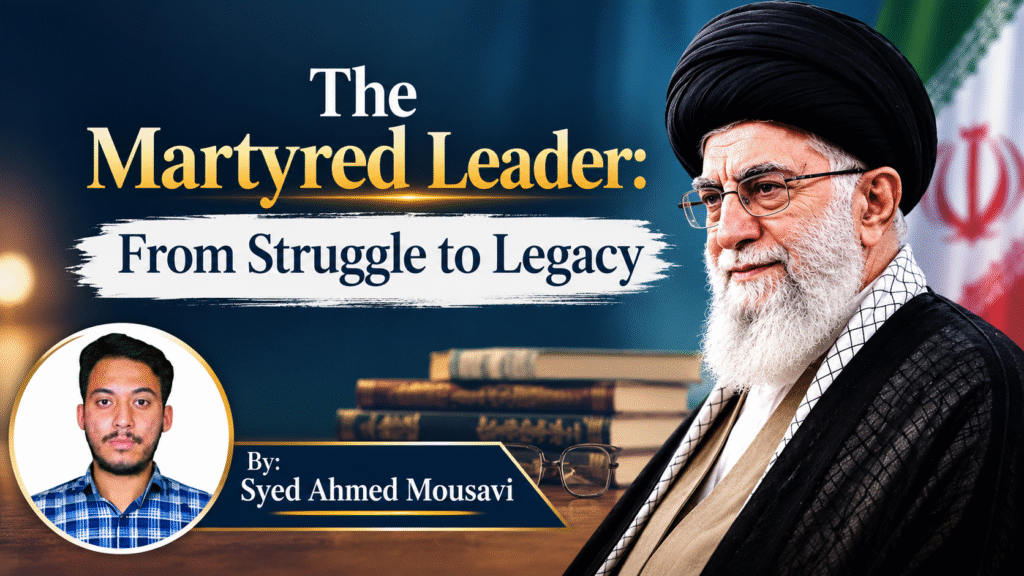
The fortieth day following the burial of the martyred leader, Syed Ali Hosseini Khamenei, is not merely a reminder of the passing of a figure or the end of an earthly life. Rather, it is an opportunity to revisit a path and a vision that became enduring through sacrifice, awareness, and steadfastness. In our religious and social culture, the fortieth day can serve as a point of transition from mourning to understanding and responsibility—a moment when the memory of a martyr moves from being a remembrance of the past to becoming a commitment to the future. The Martyred Leader From Struggle to Legacy
The Word of God beautifully describes the essence of this path:
“Among the believers are men who have remained true to the covenant they made with Allah. Some of them have fulfilled their vow and attained martyrdom, while others are still waiting, and they have never changed their commitment in the least.”
This verse presents a clear picture of what it means to remain faithful to the divine covenant—a covenant that, in the life of the martyr, was not merely a claim but something given meaning through action. By choosing a path of sacrifice and selflessness, the martyr fulfilled his responsibility toward his faith, his people, and his ideals. Yet martyrdom is not the end of this journey. What remains after martyrdom is a legacy that must continue through the thoughts and actions of future generations.
Leadership: A Trust to Serve
In the view of the martyred leader, leadership and social responsibility were less about privilege and position and more about a profound trust to serve the people. This perspective distances a leader from the pursuit of power and makes him accountable for the destiny of society.
Throughout his years of service, he sought to eliminate the gap between ideals and action. Difficulties, crises, and threats were not simply obstacles that called for retreat; rather, they were opportunities to test faith, perseverance, sacrifice, and loyalty to the people and to cherished values.
From this perspective, one of the most important dimensions of his legacy can be found in the concept of responsibility—a responsibility that begins with leaders and officials but extends to every member of society, especially the younger generation.
From Mourning to Social Responsibility
Honoring a martyr is not limited to holding ceremonies, displaying portraits, or repeating his name. If the memory of a martyr is to endure, its impact must be visible in the behavior, culture, and decisions of society.
On the fortieth day following his burial, the important question is not only, “What did he do?” but the more fundamental question is, “What will we do with his legacy?”
The martyr shaped his path through choice and action. Now, the continuation of that path depends on how faithfully we uphold the values for which he stood. If martyrdom is to become a living legacy, it must be reflected in serving the people, defending justice, strengthening hope, embracing responsibility, promoting unity, and working for the progress of society.
A Legacy for the Next Generation
Young people today face challenges, complexities, and circumstances different from those experienced by previous generations. Yet virtues such as courage, honesty, unity, faith, and responsibility never become outdated.
The martyred leader regarded young people as the nation’s capital and its hope for the future, emphasizing the role of faith, knowledge, motivation, hope, innovation, and responsibility in shaping the future. From this perspective, youth is not merely a stage of life; it is a spirit of movement, learning, creativity, accepting responsibility, and striving to build the future.
The emphasis on “education, spiritual refinement, and physical exercise” reflects this comprehensive approach to developing the younger generation—a generation that should pursue academic growth while also cultivating ethics, spirituality, and physical well-being. Providing capable and skilled young people with opportunities, trusting domestic capabilities, and enabling them to participate in scientific, cultural, economic, and administrative fields are also part of the path toward building a dynamic and strong future.
From this perspective, passing the martyr’s legacy to future generations does not mean remaining trapped in the past. Rather, it means drawing enduring principles from his life and struggle and transforming those principles into a resource for building tomorrow.
The next generation will not necessarily experience exactly the same circumstances as previous generations. Their challenges will change, and so will the issues they face. Yet faith, knowledge, hope, courage, service to the people, and a sense of responsibility can continue to serve as guiding lights.
A New Covenant on the Fortieth Day
The fortieth day is not the end of the journey; it is the beginning of a new commitment. It is a commitment to ensuring that the light kindled through faith, sacrifice, and selflessness does not fade in the hands of today’s generation, but is passed from one generation to another—so that future generations may also understand that the dignity and progress of a nation are built not through nostalgia alone, but through faith, knowledge, effort, responsibility, and loyalty to great ideals.